On this page 10 sections
In short
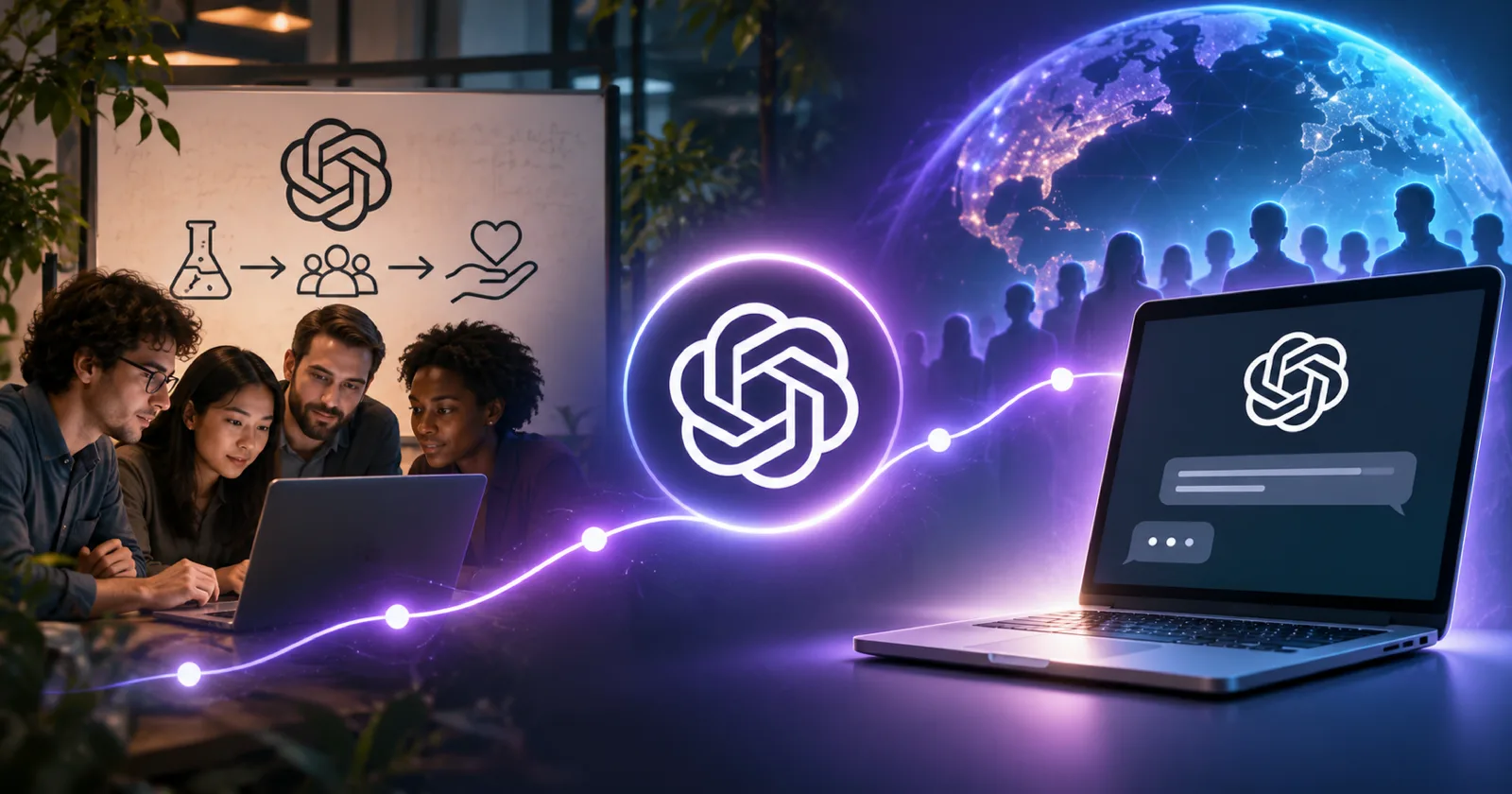
OpenAI was founded in 2015 as a nonprofit lab to ensure advanced AI benefits humanity. High computing costs led it to create a capped profit arm in 2019 and partner with Microsoft. ChatGPT, launched in 2022, reached 900 million weekly users by February 2026, and OpenAI became a nonprofit controlled public benefit corporation in 2025.
Overview
OpenAI was announced in December 2015 by a group that included Sam Altman, Greg Brockman, Ilya Sutskever and Elon Musk, among others. It was set up as a nonprofit research laboratory with a mission to ensure that artificial general intelligence, meaning AI systems that can match or outperform people at most valuable work, benefits all of humanity. At the time few people outside the research community paid much attention.
Seven years later, the launch of ChatGPT in November 2022 made OpenAI one of the most talked about companies in the world. The tension between its original nonprofit vision and the commercial demands of building frontier AI has shaped almost every major decision since. That tension makes it one of the most instructive origin stories in modern business.
Market Problem
In 2015 the most advanced AI research was concentrated inside a handful of large technology companies. OpenAI's founders worried that a technology this powerful could end up controlled by a few firms focused mainly on profit. They wanted an independent organisation that would publish research and keep safety and broad benefit at the centre.
The practical problem appeared quickly. Training state of the art AI models requires vast computing power, specialised chips and top researchers, all of which are extremely expensive. Donations alone could not fund that scale. A nonprofit lab could set the mission, but it could not easily raise the billions needed to pursue it.

Strategy Used
OpenAI's answer was to build a hybrid structure. In 2019 it created a capped profit company, controlled by the nonprofit, that could take outside investment while limiting returns to investors. That same year Microsoft made its first major investment and became OpenAI's main cloud computing partner, a relationship that later grew much larger.
The product strategy shifted too. Instead of only publishing research, OpenAI began releasing models through an application programming interface for developers, then through a consumer app. ChatGPT, launched as a research preview, put a powerful language model behind a simple chat box. Its ease of use turned an advanced technology into something anyone could try in seconds.
Execution Breakdown
ChatGPT spread faster than almost any consumer product before it, largely through word of mouth and social sharing. OpenAI followed with paid subscriptions, business plans, newer models and tools for developers, turning attention into revenue. In February 2026 it said ChatGPT had reached 900 million weekly active users and 50 million paying subscribers.
The company's structure came under strain as it grew. Leadership turmoil in November 2023, when Altman was briefly removed as chief executive and then returned, showed how difficult governance had become. In October 2025 OpenAI completed a recapitalisation that turned its for profit arm into OpenAI Group, a public benefit corporation that remains controlled by the nonprofit. Microsoft holds about 27% of the new company. In early 2026 OpenAI announced a $110 billion funding round at a $730 billion pre money valuation.
Marketing Framework Applied
OpenAI's origin is a strong illustration of mission led branding. Its stated purpose, safe AI that benefits everyone, attracted researchers who might otherwise have joined larger rivals and helped build public trust in a new kind of company. ChatGPT then applied the product led growth model: the product was the marketing, and every shared conversation acted as a demonstration.
The company's later choices also show the classic tension between mission and money that faces many purpose driven organisations. Each structural change tried to keep the mission credible while giving investors enough reason to fund it. How well that balance holds is something the market and regulators continue to watch. Smaller companies face the same question on a different scale when they decide how to fund growth, a topic covered in our Growth Accelerator 90 programme.

Numbers & Growth Metrics
Key reported figures as of early 2026:
900 million weekly active ChatGPT users, announced by OpenAI in February 2026
50 million paying subscribers, according to the same announcement
A $110 billion funding round at a $730 billion pre money valuation, with Amazon, Nvidia and SoftBank among investors
Microsoft's stake of about 27% in OpenAI Group, valued at around $135 billion when the recapitalisation closed in October 2025
ChatGPT launched in November 2022, roughly seven years after OpenAI was founded
What Entrepreneurs Can Learn
- A mission attracts talent and trust. OpenAI's clear purpose helped it compete for the best people before it had products or profits.
- Your structure must match your capital needs. A nonprofit model could not fund frontier research, so OpenAI had to redesign itself more than once.
- Simplicity unlocks adoption. The breakthrough was not only the model but the plain chat interface that made it usable by anyone.
Actionable Takeaways for SMEs
Lessons you can apply even without billions in funding:
Write a one sentence mission that explains why your business exists beyond making money
Check whether your legal and ownership structure suits how you plan to raise money and grow
Put your most powerful capability behind the simplest possible interface for customers
Let customers share results easily, because word of mouth is still the cheapest growth channel
Review your governance early, including who can make major decisions, before growth tests it
Sources
Want growth like this for your business?
We turn these strategies into a simple plan for your brand: positioning, website, marketing and sales.