On this page 10 sections
In short
PayPal grew from eBay's payment tool into a global fintech after its 2015 spin off. It partnered with card networks, scaled Braintree and Venmo and added new financial services. In 2025 it processed $1.79 trillion in payment volume with $33.2 billion revenue and 439 million active accounts, while refocusing on its core checkout.
Overview
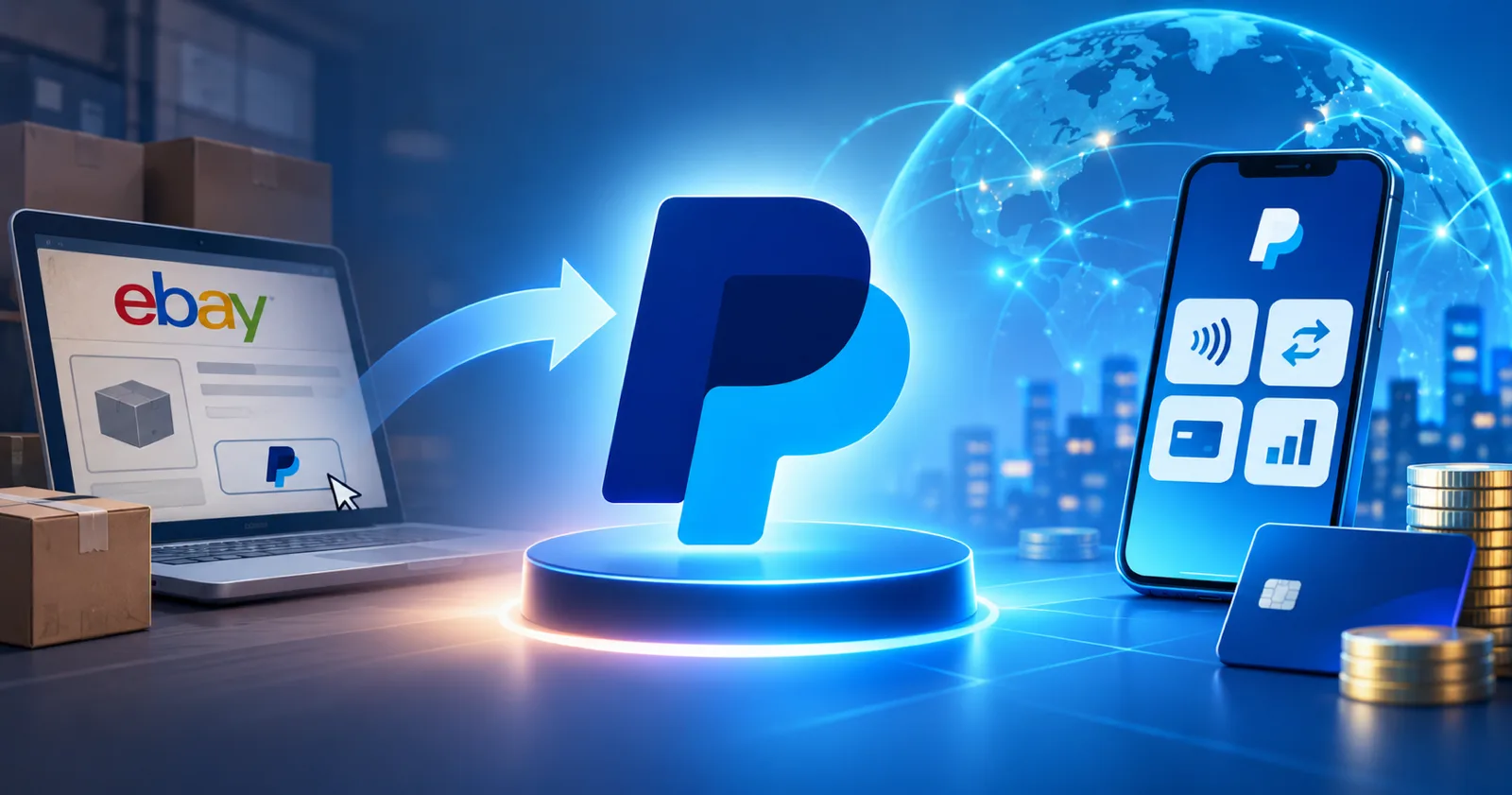
PayPal's story starts in 1998 with Confinity, a start up co founded by Peter Thiel, Max Levchin and others, which merged with Elon Musk's X.com in 2000. The combined company became PayPal, the default way to pay on eBay, which bought it in 2002 for about $1.5 billion. In 2015 PayPal separated from eBay and became an independent public company. Since then it has tried to transform from a checkout button into a full digital finance platform for consumers and merchants. Its progress, and its setbacks, show how difficult it is for an early digital leader to keep its edge once the market it created becomes crowded with well funded rivals.
Market Problem
In the early internet era, buying from a stranger online felt risky. Shoppers did not want to type card details into unknown websites, and small sellers could not easily accept cards. PayPal solved that trust gap by standing in the middle.
By the mid 2010s the problem had changed. Smartphones, mobile wallets from big tech companies and new payment start ups threatened to make PayPal's button less essential. Its dependence on eBay was also a risk, because eBay planned to move its own payments in house. Meanwhile, shoppers were becoming used to saving cards inside apps and browsers, which removed some of the friction PayPal had been built to solve.

Strategy Used
Independence gave PayPal freedom to partner with companies eBay saw as rivals, including card networks and big tech platforms. The strategy rested on three pillars: keep the branded checkout trusted and fast, power payments behind the scenes for large merchants through Braintree, and win younger users with Venmo, a social payment app that came with the Braintree acquisition in 2013.
PayPal also expanded into buy now pay later, savings, crypto features and merchant lending to give people more reasons to keep money inside its ecosystem.
The thinking was that a customer who only uses PayPal at checkout is easy to lose, while a customer who also keeps a balance, splits bills with friends and pays in instalments has many reasons to stay. Every extra service was meant to raise engagement and make the wallet harder to replace.
Execution Breakdown
PayPal signed agreements with Visa and Mastercard in 2016, reducing friction with the networks. It made acquisitions such as iZettle for in store payments and Honey for shopping rewards. During the pandemic, online shopping lifted volumes sharply.
Growth then slowed as competition intensified, and the company's share price fell well below its 2021 peak. Leadership changed in 2023, and the new team focused on profitable growth, improving the branded checkout and monetising Venmo more effectively rather than adding new products.
Part of that work was simplifying the checkout itself. Faster guest checkout, fewer pop ups and better recognition of returning customers were designed to raise conversion for merchants, because merchants choose payment options based on how many shoppers complete a purchase. Venmo's challenge was different: huge popularity with consumers, but relatively little revenue per user.
Marketing Framework Applied
PayPal's model is a two sided network: consumers join because merchants accept PayPal, and merchants accept it because consumers trust it. Its transformation applied the ecosystem strategy, adding services around the core wallet to raise engagement and lifetime value. The current reset is a return to the core value proposition, which in marketing terms means reinforcing the brand promise of safe, fast checkout before expanding further. The lesson is that an ecosystem only works when its centre stays strong, because every surrounding product depends on customers choosing the core service first. For smaller merchants, a fast, trusted checkout on a well built website is the equivalent first step.

Numbers & Growth Metrics
PayPal's full year 2025 results, published in February 2026, show a very large but slower growing business:
Net revenues of $33.2 billion, up 4%
Total payment volume of $1.79 trillion, up 7%
439 million active accounts at year end
GAAP operating margin of 18.3%
Free cash flow of $5.6 billion, down from $6.8 billion in 2024
- The gap between volume growth and revenue growth shows that much of PayPal's new volume comes from lower margin processing for large merchants rather than from its branded button.
What Entrepreneurs Can Learn
- Trust is a product. PayPal won because it made strangers comfortable paying each other online, not because its technology was unique.
- Independence can unlock growth. Leaving eBay let PayPal partner widely and reach far more merchants.
- Expansion has limits. Adding many products did not replace the need to keep the core checkout experience excellent.
Actionable Takeaways for SMEs
Use PayPal's journey to review your own customer experience:
Offer payment methods your customers already trust and use daily
Display security and refund information clearly at checkout
Reduce checkout to as few steps as possible, especially on mobile
Add new services only when your main offer is consistently strong
Track repeat purchase rates to see whether customers trust you enough to return
Sources
Want growth like this for your business?
We turn these strategies into a simple plan for your brand: positioning, website, marketing and sales.