On this page 10 sections
In short
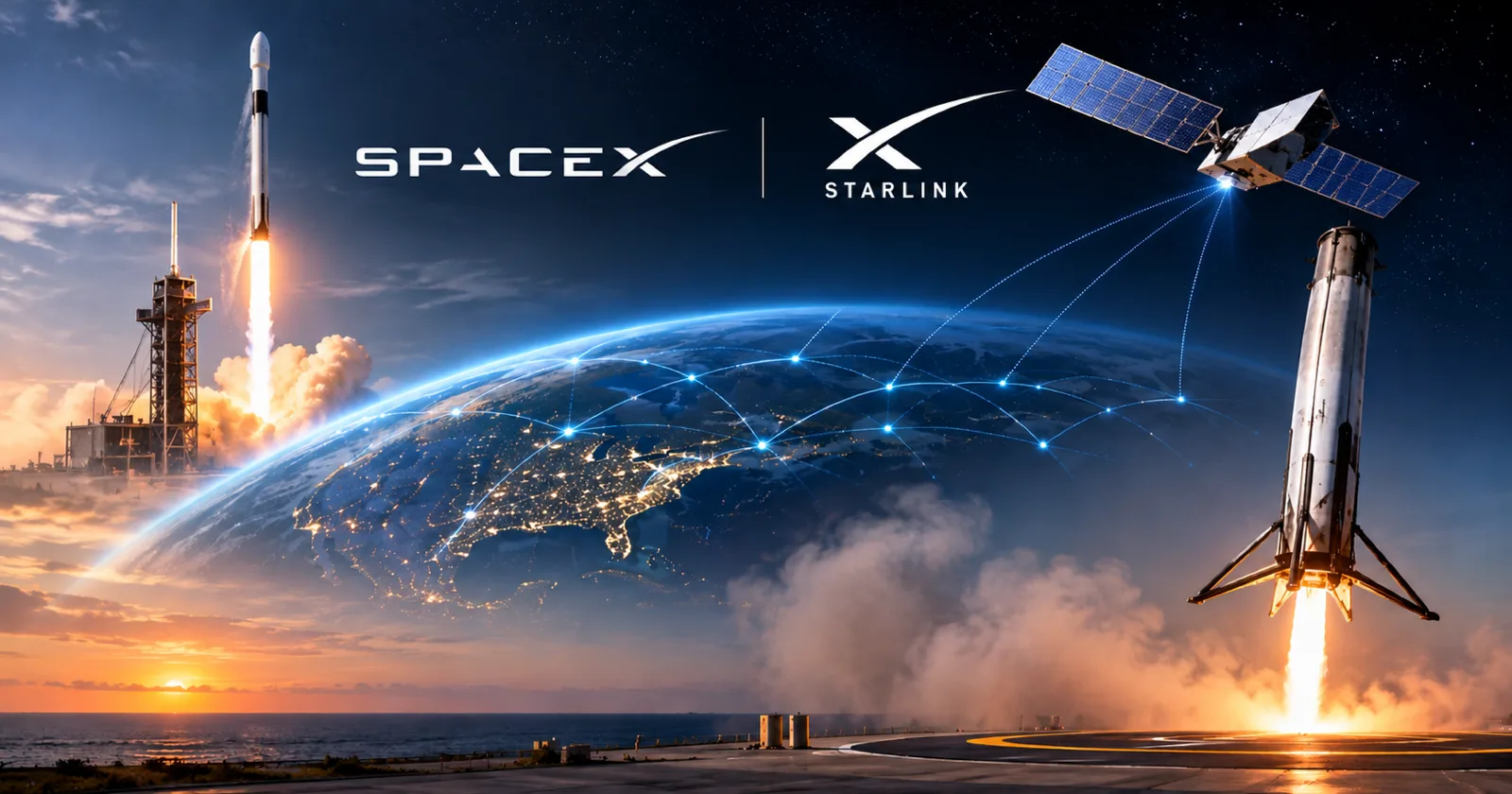
SpaceX, founded in 2002, cut launch costs by building most parts in house and landing Falcon 9 boosters for reuse. Starlink, its satellite internet service, became its own biggest customer and a recurring revenue stream. In 2025 SpaceX flew a record 165 Falcon 9 launches, with one booster reaching 32 flights.
Overview
Elon Musk founded Space Exploration Technologies, better known as SpaceX, in 2002 with the long term goal of making life multiplanetary. In the short term, the goal was more practical: cut the cost of reaching orbit. The company nearly failed. Its first three Falcon 1 launches ended in failure, and the fourth, in September 2008, became the first privately developed liquid fuelled rocket to reach orbit. Weeks later NASA awarded SpaceX a cargo contract that kept it alive.
Today SpaceX dominates global launch. In 2025 it flew 165 Falcon 9 missions, a record. The story behind that number is one of the clearest examples of product strategy built around a single, bold design choice: reusability.
Market Problem
For decades, rockets were thrown away after a single flight. Imagine building a new airliner for every journey and you begin to understand why launching satellites cost so much. Most launch providers were tied to government programmes with little pressure to reduce cost, and the number of launches each year stayed low.
High prices limited what could be built in space. Businesses that might have used satellites for communication, imaging or research could not justify the cost. The market was small because launch was expensive, and launch was expensive because the market was small.

Strategy Used
SpaceX attacked cost from two directions. First, it built most of its rocket components in house rather than buying them from a long chain of suppliers. Vertical integration gave it control over design, speed and price. Second, it made the first stage of its Falcon 9 rocket land back on Earth so it could fly again. In December 2015 SpaceX landed an orbital class booster for the first time.
The company then created its own demand. Starlink, a constellation of satellites providing internet from low Earth orbit, needed thousands of satellites. SpaceX became its own biggest customer, which kept launch cadence high, improved reusability faster and spread fixed costs over many more flights.
Execution Breakdown
SpaceX's engineering culture favours rapid testing and learning from failures in public. Early landing attempts ended in explosions that were shared openly. Each failure produced data that improved the next attempt. That approach is now visible again in the development of Starship, its next generation fully reusable vehicle, which has flown repeated test flights.
Credibility followed performance. In May 2020 the Demo 2 mission carried NASA astronauts to the International Space Station, the first crewed orbital launch from the United States since the Space Shuttle retired in 2011. By 2025 Falcon 9 boosters were routinely landing and flying again, with a single booster reaching 32 flights. Starlink grew into a global consumer and business internet service, giving SpaceX recurring subscription revenue alongside launch contracts.
Marketing Framework Applied
SpaceX's product strategy follows the logic of cost leadership combined with a platform play. Reusability and vertical integration make each launch cheaper, which lets the company win commercial and government contracts on price and reliability. Starlink turns that low cost launch capacity into a consumer platform with recurring revenue.
It also demonstrates the build, measure, learn cycle from lean start up thinking, applied to heavy engineering. Rather than perfecting a design on paper for years, SpaceX builds, flies, measures and improves. Its public livestreams double as marketing, turning launches into global events that build brand awareness without traditional advertising. Any business can borrow that idea with behind the scenes video content that shows how its product is made.

Numbers & Growth Metrics
Figures reported by Space.com from company records at the end of 2025:
165 Falcon 9 orbital launches in 2025, up from 134 in 2024 and 25 in 2020
Boosters landed successfully on 162 of those 165 launches
A record of 32 flights for a single Falcon 9 booster
123 Starlink missions in 2025 carrying more than 3,000 satellites
More than 9,300 active Starlink satellites in orbit
What Entrepreneurs Can Learn
- One design choice can change an industry. Reusability transformed the economics of launch more than any marketing could.
- Become your own first customer. Starlink gave SpaceX steady demand for its launches and a second business.
- Iterate in public when stakes allow. Sharing failures openly built a culture of learning and, eventually, credibility.
Actionable Takeaways for SMEs
Practical ways to apply SpaceX's thinking at a smaller scale:
Identify the single biggest cost in your service and ask how it could be reused or shared
Bring a critical step in house if suppliers slow you down or set your prices
Create a product that uses your own capacity, filling quiet periods with your own demand
Run small, fast experiments instead of long planning cycles, and record what each one teaches
Turn your work into content, such as behind the scenes videos, to build awareness without ad spend
Sources
Space.com: SpaceX shatters its rocket launch record yet again: 165 orbital flights in 2025 (December 2025)
Satellite Today: SpaceX hits milestone of more than 10,000 Starlink satellites launched (October 2025)
NASA: NASA Astronauts Launch from America in Historic Test Flight of SpaceX Crew Dragon (May 2020)
Want growth like this for your business?
We turn these strategies into a simple plan for your brand: positioning, website, marketing and sales.